Rekoner
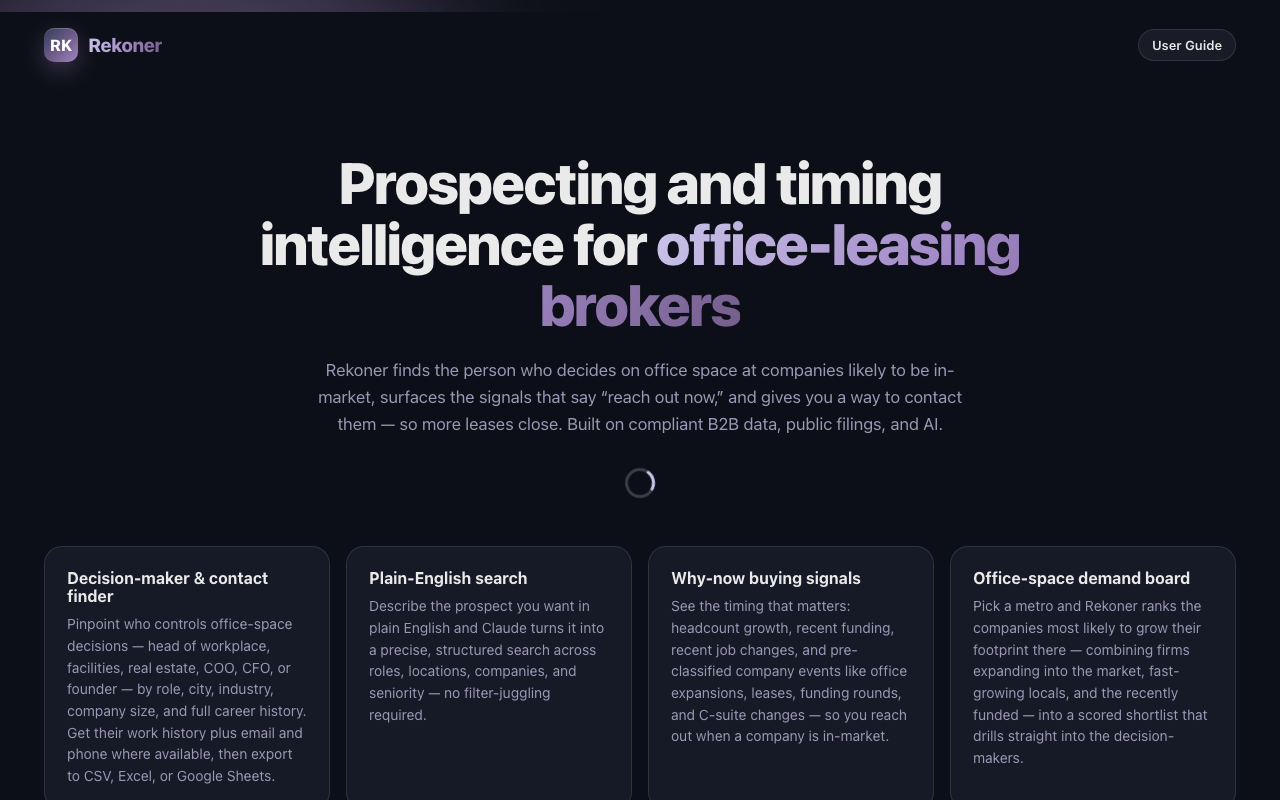
Timing intelligence for office-leasing brokers. Rekoner blends compliance-vetted B2B data, public filings, and Claude AI to surface which companies are actually in-market for space — and who signs the lease. Search in plain English, watch "why-now" signals, work a ranked metro demand board, and export anywhere.
Visit the site →Rekoner is a prospecting and timing tool I built for commercial real-estate brokers who do office leasing. The whole point is to answer two questions a broker actually cares about: which companies are in-market for space right now, and who in that company makes the leasing call. It pulls together compliance-vetted B2B data, public filings, and Claude AI to figure that out instead of leaving you to guess.
Why I built it
Brokerage runs on timing. The same outreach lands very differently depending on whether a company is about to outgrow its floor or just signed a ten-year lease last quarter. The trouble is that the signal — headcount climbing, a funding round, a key hire, some company event that means change is coming — is scattered across a dozen places nobody has time to check by hand. I wanted one place that watches for the why now and tells you before your competition figures it out.
How it works
You can search in plain English. Type what you're looking for the way you'd say it out loud, and Rekoner turns it into a structured query under the hood — no filter gymnastics. From there a few things do the heavy lifting:
"Why-now" signals — headcount growth, funding rounds, job changes, and company events that suggest a move is coming.
A metro-level demand board that ranks prospects by how likely they are to be in-market, so you can work the top of the list.
Watchlists and email digests that flag movement on the accounts you care about, so you're not re-running the same search every morning.
Hands-free prospecting over email, plus export to CSV, Excel, or Sheets when you want the data in your own stack.
Claude does the interpretation work — reading the messy stuff and turning it into a who-and-why you can act on. You can poke at it yourself at rekoner.dev.
What I learned
The hard part was never finding data — it's everywhere. It was deciding which signals actually mean a company is about to need space, and ranking them honestly instead of dumping a list on someone. Getting the plain-English search to feel less like a search box and more like asking a colleague took the most iteration, and it's the part I'm proudest of.